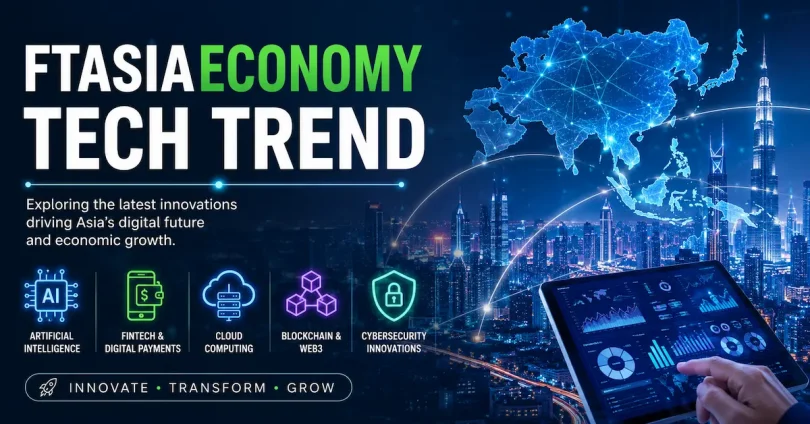

The FTAsiaEconomy tech trend is becoming an important topic for anyone interested in Asia’s digital economy, business growth, fintech, artificial intelligence, and emerging technologies.
Asia is no longer just following global technology trends. In many areas, it is helping shape them.
From AI-powered banking and cashless payments to smart cities, cloud computing, cybersecurity, blockchain, automation, and green technology, digital innovation is changing how Asian businesses, governments, and consumers operate.
But many online articles explain this topic in a very basic way. They list technologies without clearly explaining what they mean, why they matter, or how they are transforming real industries.
This guide gives you a clearer and more practical explanation of the FTAsiaEconomy tech trend. You will learn what it means, which technologies are driving it, how it affects different industries, why Asia is becoming a global digital leader, and what businesses should expect in the coming years.
Quick Answer: What Is the FTAsiaEconomy Tech Trend?
The FTAsiaEconomy tech trend refers to the growing use of technologies such as artificial intelligence, fintech, cloud computing, blockchain, cybersecurity, big data, IoT, smart cities, automation, and green technology across Asian economies.
It shows how digital innovation is transforming finance, healthcare, manufacturing, retail, education, logistics, government services, and everyday life across Asia.
In simple words, it is about how technology is helping Asia become faster, smarter, more connected, and more competitive.
FTAsiaEconomy Tech Trend at a Glance
| Technology Trend | Role in Asia’s Economy |
| Artificial Intelligence | Improves automation, decision-making, fraud detection, and productivity |
| FinTech | Expands digital payments, mobile banking, online lending, and financial inclusion |
| Cloud Computing | Helps businesses store data, scale operations, and support remote work |
| Big Data Analytics | Turns customer, market, and business data into useful insights |
| Cybersecurity | Protects digital systems, financial platforms, and customer information |
| Blockchain | Improves transparency, digital identity, payments, and supply chain tracking |
| Internet of Things | Connects devices, factories, vehicles, homes, and city systems |
| Smart Cities | Improves transport, energy use, public services, and urban planning |
| Green Technology | Supports sustainability, renewable energy, and efficient resource use |
| Automation | Reduces repetitive work and improves speed, accuracy, and productivity |
Is FTAsiaEconomy a Company, Platform, or Technology?
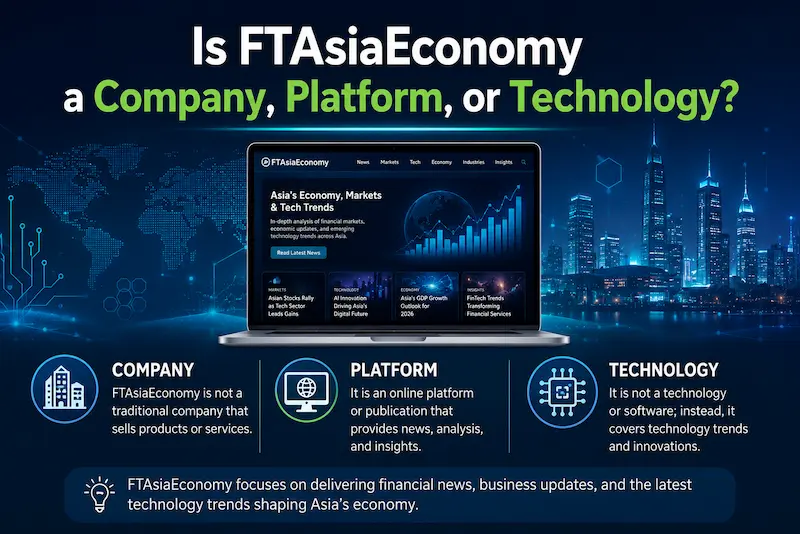
One common misunderstanding is that FTAsiaEconomy itself is a technology.
It is better understood as a finance, economy, and technology-focused information platform or publication that discusses business trends, financial developments, technology news, and digital transformation topics related to Asia.
So, when people search for the FTAsiaEconomy tech trend, they are usually not looking for one specific software or product. They want to understand the major technology trends being discussed in relation to Asia’s economic growth.
That distinction matters because the phrase is not about one single tool. It covers a wider movement of digital transformation across Asian markets.
Why the FTAsiaEconomy Tech Trend Matters
Technology is now one of the biggest forces shaping economic growth. Businesses use it to reduce costs, improve customer experience, make faster decisions, and compete in global markets.
The FTAsiaEconomy tech trend matters because Asia is home to some of the world’s fastest-growing digital economies. Countries across the region are investing in better digital infrastructure, artificial intelligence, fintech platforms, e-commerce systems, smart manufacturing, and cybersecurity.
This trend affects:
- Business owners looking for growth opportunities
- Investors watching emerging markets
- Startups building new digital products
- Students learning about future careers
- Governments improving public services
- Consumers using digital payments, online shopping, and mobile services
In short, this trend is not only about technology companies. It affects almost every sector of the economy.
Why Asia Is Leading Digital Transformation
Asia has become one of the strongest regions for digital growth because of several important factors.
1. Large Digital Population
Asia has a massive number of internet and smartphone users. This creates strong demand for digital services such as mobile banking, e-commerce, online education, streaming, food delivery, ride-hailing, and digital payments.
When millions of people adopt digital tools quickly, businesses are forced to innovate faster.
2. Strong Government Support
Many Asian governments are investing in digital infrastructure, startup programs, smart city projects, artificial intelligence research, and technology education.
Government support helps create a better environment for businesses and startups to develop new digital solutions.
3. Fast-Growing Startup Ecosystem
Asia has a powerful startup ecosystem. Entrepreneurs are building solutions for finance, healthcare, education, agriculture, logistics, retail, manufacturing, and sustainability.
This startup activity speeds up innovation and attracts investors from around the world.
4. Advanced Manufacturing Base
Asia is already a global manufacturing hub. Now, factories are becoming smarter through automation, robotics, IoT sensors, AI-powered quality control, and predictive maintenance.
This shift is helping manufacturers reduce waste, improve safety, and increase productivity.
5. High Consumer Adoption
Consumers across Asia often adopt mobile-first technologies quickly. Digital wallets, QR payments, mobile shopping, live commerce, and app-based services have become part of daily life in many markets.
This strong adoption gives businesses more confidence to invest in digital products.
Core Technologies Behind the FTAsiaEconomy Tech Trend
The FTAsiaEconomy tech trend is powered by several connected technologies. Each one plays a different role, but together they create a stronger digital economy.
1. Artificial Intelligence
Artificial intelligence is one of the most important technologies behind Asia’s digital growth.
AI helps businesses analyze data, automate tasks, improve customer service, detect fraud, recommend products, forecast demand, and make faster decisions.
Common Uses of AI
- Fraud detection in banking
- Product recommendations in e-commerce
- AI chatbots for customer support
- Medical image analysis in healthcare
- Predictive maintenance in factories
- Automated document processing
- Demand forecasting for retailers
- Language translation and content generation
AI is not only useful for large companies. Small businesses can also use AI tools for customer service, marketing, reporting, and workflow automation.
2. Machine Learning
Machine learning is a part of AI that allows systems to improve by learning from data.
Businesses use machine learning to identify patterns and make predictions. For example, a bank can use machine learning to detect unusual transactions, while an online store can use it to suggest products based on customer behavior.
Machine Learning Helps With:
- Fraud detection
- Search results
- Customer segmentation
- Risk analysis
- Sales forecasting
- Cyber threat detection
- Equipment failure prediction
The more quality data these systems receive, the more useful they become.
3. FinTech and Digital Payments
FinTech is one of the strongest parts of the FTAsiaEconomy tech trend.
Across Asia, digital payments have changed how people send money, shop, save, invest, and access financial services.
Popular FinTech Innovations
- Mobile wallets
- QR code payments
- Instant bank transfers
- Digital banks
- Buy Now, Pay Later services
- Online lending platforms
- Investment apps
- Cross-border payment systems
- Digital identity verification
FinTech is especially important because it supports financial inclusion. People who previously had limited access to traditional banking can now use mobile-based financial services.
4. Cloud Computing
Cloud computing allows businesses to use storage, software, servers, and computing power through the internet instead of relying only on physical infrastructure.
This is important for both startups and large enterprises because it reduces upfront costs and makes scaling easier.
Benefits of Cloud Computing
- Lower infrastructure costs
- Faster business expansion
- Remote work support
- Better collaboration
- Automatic software updates
- Flexible storage
- Disaster recovery
- Improved data access
Cloud computing also supports AI, big data, e-commerce, mobile apps, and digital banking platforms.
5. Big Data Analytics
Every digital interaction creates data. Businesses use big data analytics to turn this information into useful insights.
For example, retailers can understand what customers are buying, banks can analyze risk, and governments can improve public services based on real usage patterns.
Big Data Helps Organizations Understand:
- Customer behavior
- Market trends
- Sales performance
- Financial risks
- Supply chain problems
- Product demand
- Operational efficiency
Without data analytics, businesses often rely on guesswork. With analytics, they can make more informed decisions.
6. Blockchain Technology
Blockchain is often connected with cryptocurrency, but its business uses go far beyond digital coins.
Blockchain can create secure and transparent records. This makes it useful for finance, logistics, healthcare, identity verification, and supply chain management.
Blockchain Use Cases
- Cross-border payments
- Smart contracts
- Digital identity
- Supply chain tracking
- Asset tokenization
- Healthcare record security
- Product authenticity checks
- Trade finance
The main value of blockchain is transparency, security, and trust.
7. Cybersecurity
As businesses become more digital, cybersecurity becomes more important.
Banks, e-commerce platforms, healthcare providers, government services, and cloud-based businesses all need strong protection against cyber threats.
Important Cybersecurity Practices
- Multi-factor authentication
- Zero Trust security
- Data encryption
- Identity verification
- Threat monitoring
- Secure cloud systems
- Employee security training
- Regular software updates
Cybersecurity is not only an IT issue. It is a business trust issue. If customers do not trust a company with their data, they may stop using its services.
8. Internet of Things
The Internet of Things, or IoT, connects physical devices to the internet so they can collect and share data.
IoT is used in homes, factories, transportation, agriculture, energy systems, and smart cities.
Examples of IoT
- Smart home devices
- Industrial sensors
- Connected vehicles
- Smart meters
- Wearable health devices
- Smart irrigation systems
- Fleet tracking systems
- Factory monitoring tools
IoT helps organizations monitor performance, reduce waste, and solve problems faster.
9. Smart Cities
Smart cities are one of the most important parts of Asia’s digital future.
A smart city uses technology to improve public services, transportation, energy, safety, waste management, and urban planning.
Smart City Technologies Include:
- Smart traffic lights
- Smart parking systems
- Digital public transport systems
- Environmental monitoring
- Smart waste management
- Energy-efficient street lighting
- Digital government services
- Emergency response systems
Smart cities can improve quality of life while helping governments manage resources more efficiently.
10. Green Technology
Green technology is becoming increasingly important as businesses and governments focus on sustainability.
Technology is now being used to reduce energy consumption, manage carbon emissions, support renewable energy, and improve environmental performance.
Examples of Green Technology
- Renewable energy systems
- Smart grids
- Electric vehicle infrastructure
- Energy-efficient data centers
- Carbon tracking software
- Sustainable manufacturing
- Smart water management
- Waste reduction technologies
Green technology shows that digital transformation is not only about profit. It is also about long-term sustainability.
How These Technologies Work Together
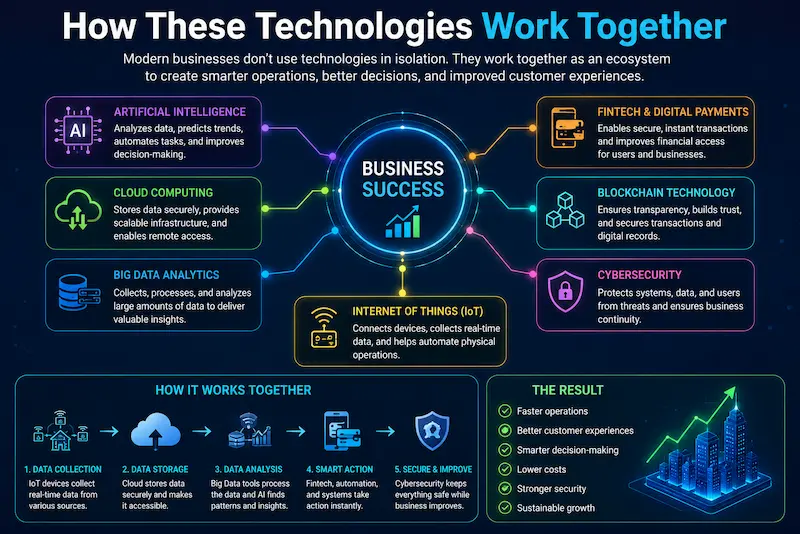
One mistake many articles make is discussing each technology separately. In reality, these technologies often work together.
For example, an e-commerce business may:
- Store customer data in the cloud
- Use AI to recommend products
- Analyze buying behavior with big data
- Accept payments through digital wallets
- Protect customer data with cybersecurity tools
- Track inventory through IoT systems
- Use automation for order processing
This combination creates a smarter, faster, and more efficient business.
The real power of the FTAsiaEconomy tech trend comes from integration. Technologies become more valuable when they support each other.
Industries Most Affected by the FTAsiaEconomy Tech Trend
The FTAsiaEconomy tech trend is not limited to software companies. It is transforming almost every major industry.
Banking and Financial Services
Banking has changed dramatically because of digital technology.
Customers now expect fast, secure, and mobile-friendly financial services. Banks and fintech companies are using AI, mobile apps, digital wallets, and automation to meet these expectations.
Key Changes in Banking
- Mobile banking apps
- AI fraud detection
- Digital identity verification
- Instant money transfers
- QR code payments
- Online investment platforms
- Automated customer support
- Digital lending
Benefits
- Faster transactions
- Lower costs
- Better security
- More financial access
- Improved customer experience
FinTech is one of the clearest examples of how technology can reshape an entire industry.
Healthcare
Healthcare providers are using digital tools to improve patient care, reduce costs, and make medical services more accessible.
Healthcare Technologies
- AI-assisted diagnosis
- Electronic health records
- Telemedicine
- Remote patient monitoring
- Wearable health devices
- Predictive disease analysis
- Medical data analytics
These tools help doctors make better decisions and allow patients to access care more easily.
Manufacturing
Manufacturing is entering a new stage often called Industry 4.0.
Factories are using robotics, AI, IoT sensors, automation, and data analytics to improve production.
Smart Manufacturing Technologies
- Industrial robots
- Predictive maintenance
- AI quality control
- Automated warehouses
- Digital twins
- Smart supply chains
- IoT sensors
Benefits
- Less downtime
- Better product quality
- Lower waste
- Faster production
- Improved worker safety
Asia’s strong manufacturing base makes this trend especially important.
E-Commerce and Retail
E-commerce continues to grow across Asia, supported by mobile payments, social commerce, AI recommendations, and fast logistics.
Retail Innovations
- Personalized product recommendations
- Mobile shopping apps
- One-click checkout
- Live shopping
- Digital wallets
- Same-day delivery
- AI customer support
- Inventory automation
Retailers that use digital tools effectively can improve customer experience and increase sales.
Education
Education has become more digital through online learning platforms, virtual classrooms, AI tutoring, and mobile learning apps.
Digital Education Technologies
- Learning management systems
- AI tutoring tools
- Online certifications
- Virtual classrooms
- Interactive assessments
- Educational apps
- Digital course platforms
Technology helps students access learning from anywhere, but it also requires better digital skills and reliable internet access.
Agriculture
Agriculture is also becoming more technology-driven.
Farmers are using sensors, drones, weather data, satellite monitoring, and AI tools to improve production and reduce waste.
Smart Farming Includes:
- Soil monitoring
- Weather forecasting
- Drone crop inspection
- Automated irrigation
- AI crop analysis
- Satellite monitoring
- Smart pest detection
These technologies can help improve food production and support sustainable farming.
Transportation and Logistics
Logistics companies use digital technology to track goods, optimize routes, manage fleets, and improve delivery speed.
Logistics Technologies
- GPS tracking
- AI route planning
- Smart warehouses
- Fleet management
- Automated inventory systems
- Real-time shipment updates
- Delivery optimization tools
Customers now expect fast delivery and real-time tracking, making logistics technology more important than ever.
Government Services
Governments across Asia are using technology to improve public services and reduce paperwork.
Digital Government Services
- Online tax systems
- Digital identity platforms
- Smart city dashboards
- E-permits
- Online citizen portals
- Digital healthcare services
- Public transport apps
Digital government services can save time, reduce corruption risks, and improve access for citizens.
Energy and Sustainability
Energy systems are becoming smarter through renewable energy, smart grids, electric vehicle infrastructure, and energy monitoring tools.
Energy Technology Trends
- Smart grids
- Renewable energy management
- EV charging systems
- Energy-efficient buildings
- Smart meters
- Carbon tracking platforms
This supports both economic growth and environmental responsibility.
Traditional Business vs Digital Business
| Traditional Business | Digital Business |
| Manual processes | Automated workflows |
| Paper records | Cloud storage |
| Cash payments | Digital payments |
| Limited customer data | Real-time analytics |
| Slow reporting | Instant dashboards |
| Reactive decisions | AI-supported decisions |
| Local-only operations | Online and cross-border reach |
| Basic security | Advanced cybersecurity systems |
| Manual inventory | Smart inventory tracking |
| Fixed infrastructure | Flexible cloud systems |
This comparison shows why digital transformation is now essential for long-term competitiveness.
What Makes the FTAsiaEconomy Tech Trend Different?
Earlier technology changes were mostly about moving businesses online. Companies created websites, used email, and started storing some information digitally.
Today’s transformation is much deeper.
Modern technologies can:
- Predict customer behavior
- Automate complex decisions
- Personalize user experiences
- Process large amounts of data instantly
- Connect physical devices
- Improve sustainability
- Strengthen cybersecurity
- Support real-time business decisions
This is not just digital adoption. It is intelligent digital transformation.
Real Examples of Digital Transformation Across Asia
Different Asian countries are using technology in different ways.
Singapore
Singapore is known for smart city development, digital government services, fintech innovation, and strong technology infrastructure.
Technology is used to improve public transport, healthcare, urban planning, digital identity, and cashless payments.
India
India has seen major growth in digital payments, mobile banking, digital identity systems, fintech startups, and online financial services.
Digital tools have helped expand financial access for millions of people and small businesses.
South Korea
South Korea is strong in semiconductors, high-speed internet, robotics, smart manufacturing, gaming, and artificial intelligence.
Its advanced digital infrastructure supports both businesses and consumers.
Japan
Japan uses technology in robotics, automation, healthcare, smart transportation, and manufacturing.
Because of its aging population, Japan is also investing in assistive technologies and healthcare innovation.
China
China has invested heavily in e-commerce, digital payments, electric vehicles, AI, smart logistics, cloud computing, and manufacturing technology.
Its large consumer market helps digital platforms grow quickly.
Southeast Asia
Countries in Southeast Asia are growing quickly in e-commerce, mobile payments, ride-hailing, food delivery, digital banking, and startup innovation.
Young populations and mobile-first behavior make the region attractive for digital businesses.
Challenges of the FTAsiaEconomy Tech Trend
Although the FTAsiaEconomy tech trend creates major opportunities, it also brings challenges.
High Implementation Costs
Advanced technologies can be expensive, especially for small businesses. AI systems, cybersecurity tools, cloud migration, and automation may require investment.
Businesses need to choose technologies carefully based on real needs.
Skills Shortage
Many companies need workers with skills in AI, cybersecurity, cloud computing, data analytics, and software development.
Without trained employees, technology investments may not deliver strong results.
Cybersecurity Risks
As more services move online, cyber threats become more serious.
Businesses must protect customer data, financial information, intellectual property, and internal systems.
Data Privacy
Organizations collect more data than ever before. This creates responsibility.
Businesses must handle customer information carefully and follow relevant privacy laws.
Digital Divide
Not everyone has equal access to technology. Rural areas, small businesses, and low-income communities may face barriers such as poor internet access or limited digital skills.
Rapid Technological Change
Technology changes quickly. Businesses that fail to adapt may fall behind, but adopting every new trend without planning can also waste money.
The best approach is thoughtful, goal-based transformation.
Future of the FTAsiaEconomy Tech Trend
The FTAsiaEconomy tech trend will continue to evolve over the next several years. AI, fintech, cloud computing, cybersecurity, and smart infrastructure will remain important, but new technologies will also gain attention.
1. More Advanced AI Systems
AI will become more capable of handling complex business tasks. Companies may use AI for planning, forecasting, software development, customer support, risk analysis, and operations.
The most successful businesses will likely use AI as a support system for human teams, not simply as a replacement for workers.
2. Growth of Smart Cities
More cities across Asia will use sensors, AI, cloud systems, and digital platforms to manage traffic, energy, safety, public transport, and government services.
Smart city development will become a major part of urban planning.
3. Faster and More Connected Payments
Digital payments will continue to become faster, easier, and more secure.
Cross-border payments, mobile wallets, embedded finance, and digital banking may continue to expand.
4. Expansion of Green Technology
Sustainability will become more closely connected with digital transformation.
Businesses will use technology to reduce energy use, measure emissions, improve supply chains, and support cleaner production.
5. Edge Computing
Edge computing processes data closer to where it is created instead of sending everything to distant cloud servers.
This can improve speed and reliability for factories, healthcare systems, vehicles, and IoT devices.
6. Digital Twins
Digital twins are virtual models of real-world systems, such as factories, buildings, machines, or cities.
They help organizations test ideas, predict problems, and improve performance before making physical changes.
7. Quantum Computing
Quantum computing is still developing, but it may eventually help solve complex problems in research, finance, logistics, medicine, and cybersecurity.
It is not yet a mainstream business tool, but it is worth watching.
Practical Tips for Businesses
Businesses do not need to adopt every new technology at once. The best strategy is to focus on tools that solve real problems.
Start With Clear Goals
Before investing in technology, identify the main business problem.
For example:
- Do you want to reduce costs?
- Improve customer service?
- Increase sales?
- Protect data?
- Automate repetitive work?
- Expand online?
- Improve decision-making?
Clear goals help businesses choose the right technology.
Invest in Employee Skills
Technology works best when employees know how to use it.
Businesses should train teams in:
- AI tools
- Cybersecurity basics
- Data analysis
- Cloud platforms
- Digital collaboration
- Automation software
People are still at the center of successful digital transformation.
Protect Customer Data
Customer trust is extremely valuable.
Businesses should use strong passwords, multi-factor authentication, encryption, secure cloud systems, and regular monitoring.
Employees should also be trained to recognize phishing and other cyber threats.
Use Data Wisely
Data can improve decision-making, but only if it is accurate and used responsibly.
Businesses should track sales, customer behavior, website performance, operations, and financial results.
Good data helps companies make smarter choices.
Choose Scalable Tools
Businesses should choose technology that can grow with them.
Cloud software, modular systems, and flexible platforms are often better than tools that become outdated quickly.
Common Myths About the FTAsiaEconomy Tech Trend
Myth 1: AI Will Replace Every Job
AI may automate some tasks, but it also creates new opportunities in AI management, data analysis, cybersecurity, software development, and digital operations.
The goal should be to use AI to improve human productivity.
Myth 2: Only Large Companies Benefit
Small businesses can also benefit from cloud tools, digital payments, automation, online marketing, and AI-powered customer support.
Digital transformation is no longer only for large corporations.
Myth 3: Digital Transformation Happens Overnight
Successful transformation usually happens step by step.
Businesses need planning, training, testing, and continuous improvement.
Myth 4: Cybersecurity Is Only an IT Problem
Cybersecurity is everyone’s responsibility. One weak password or phishing email can create serious problems.
Every employee should understand basic security practices.
Myth 5: More Technology Always Means Better Results
Using more tools does not automatically make a business better.
The best results come from choosing the right technology for the right purpose.
How to Stay Updated on FTAsiaEconomy Tech Trends
Technology changes quickly, so businesses and individuals should keep learning.
Useful ways to stay updated include:
- Follow reliable business and technology publications
- Read industry reports
- Watch fintech, AI, and cybersecurity developments
- Join professional communities
- Attend webinars and conferences
- Take online courses
- Monitor startup and investment trends
- Study how leading Asian markets use technology
Continuous learning is one of the best ways to stay competitive.
FAQs About FTAsiaEconomy Tech Trend
What does FTAsiaEconomy tech trend mean?
The FTAsiaEconomy tech trend refers to the major digital technologies shaping Asia’s economy, including artificial intelligence, fintech, cloud computing, blockchain, cybersecurity, IoT, smart cities, automation, and green technology.
Is FTAsiaEconomy a technology?
No. FTAsiaEconomy is not a single technology. It is better understood as a finance and technology-related information platform or topic source. The phrase “FTAsiaEconomy tech trend” describes the technologies and digital innovations connected with Asia’s economic growth.
Why is the FTAsiaEconomy tech trend important?
It is important because technology is transforming businesses, financial systems, public services, manufacturing, healthcare, retail, education, and daily life across Asia.
Which technologies are included in the FTAsiaEconomy tech trend?
The main technologies include AI, machine learning, fintech, digital payments, cloud computing, big data analytics, blockchain, cybersecurity, IoT, smart cities, automation, and green technology.
Why is Asia becoming a global technology leader?
Asia has a large digital population, strong government investment, fast-growing startups, advanced manufacturing, mobile-first consumers, and high demand for digital services.
Final Thoughts
The FTAsiaEconomy tech trend represents more than a list of popular technologies. It reflects the wider digital transformation reshaping Asia’s economy, industries, businesses, and everyday life.
Artificial intelligence, fintech, cloud computing, cybersecurity, blockchain, IoT, smart cities, automation, and green technology are helping organizations become more efficient, data-driven, secure, and competitive.
Asia’s large digital population, strong startup ecosystem, government support, and advanced manufacturing base make the region one of the most important places for technology growth.
However, successful digital transformation requires more than simply adopting new tools. Businesses must invest in skills, protect customer data, use technology with clear goals, and stay flexible as trends continue to change.
For businesses, investors, students, and technology enthusiasts, understanding the FTAsiaEconomy tech trend is a smart way to understand where Asia’s digital future is heading.